

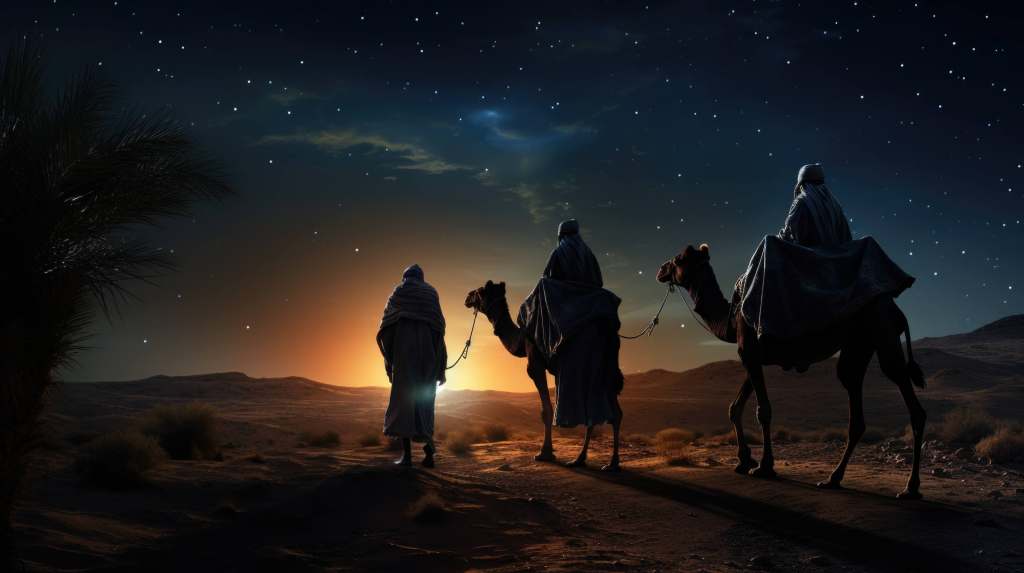
The little church where I grew up had an annual Christmas Play but couldn’t afford to have multiple set designs. In fact, keeping it simple was the theme. Our one little manger scene at the front of that small church was packed with Mary and Jesus, surrounded by Joseph, three Kings, some shepherds, a cow and a half-dozen sheep (kids in costumes).
The original manger scene was probably also crowded but not with sheep and Wise Men. By the way, there were not three and they were not kings. (In my culture, everybody brings one gift, so three gifts implies to me there must have been three givers.) A caravan of three with expensive gifts probably wouldn’t have gotten out of Babylon before being robbed! While the wise men didn’t appear that first night, shepherds did, but without dragging their herds along. Luke’s shepherd story, though, is a powerful one. (Luke likes to talk about the disenfranchised.) God told the shepherds precisely where to find the baby. The Angel of the Lord (apparently alone) announced the good news to the shepherds, and I think that was likely when the rest of heaven found out. Luke tells us “suddenly” the “hosts of heaven” appear (Lk 2:13). I assume they were surprised by the good news, but they are clearly ecstatic about it.
I suspect this is also when Satan found out about it. I think Satan then arranges for the Wise Men to come. Think about it. What did the visit of the Wise Men accomplish? The death of innocent babies in Bethlehem. Herod already had a reputation for killing anyone with aspirations for his throne (examples, ##27-29), so Herod’s response was entirely predictable. I can also add, astrology (using the stars to predict events, as a form of divination) is forbidden in Scripture (Lev. 19:26), also see for example, Isa. 47:13-15 or Deut. 18:9-14, where it is called “detestable.” While we assume it, Scripture never says God sent the star . The magi saw some astrological sign that they interpreted to mean the birth of a new Jewish king.[1] The original sign to the wise men, a star ἐν τῇ ἀνατολῇ, en tê anatolê (in the east or in Anatolia or when it rose), was gone. They had no idea where to find the baby. They had assumed it would be in the Royal Nursery in Jerusalem; hence they appeared before Herod. Once the magi (one can question how “wise” they were) alerted Herod, the die was cast. Herod acts without any further assistance from the magi. Their original announcement put into motion the death of the babies. After the magi leave, another star (apparently in the south) guides them to the Babe. Perhaps God sent this one; perhaps God did not. Scripture doesn’t say. In any case, their gifts probably funded the family’s escape to Egypt, but I would not want to suggest they were God’s only option for funding. The magi do not return to Herod because God warned them in a dream (not with a star).
So, were the magi just a disaster and nothing else? Matthew mentions the story because he wants to highlight that the entire world recognized the gospel, as Isaiah frequently noted, the nations will bring gifts to Zion. Matthew then ends his story with the Great Commission. Also, Scripture constantly reminds us that what someone intended for evil, God used for good (Gen. 50:20). I suspect one of Satan’s greatest frustrations is that God is constantly pulling good out of the evil that Satan wrought. Nonetheless, the magi story is very different from the other parts of the biblical story. In the other stories, when God gave directions, he used angels and dreams, not astrology. I think the Revelation is referring to Satan, the magi, and Herod when it says the Dragon tried to kill the baby when it was born (Rev 12:1-6). It would have succeeded, except God warned Joseph (in a dream) to flee.
In any event, the magi don’t show up on the birth night. We are told by Matthew that they visit the “child” (not babe) in the “house” (not stable). Perhaps Matthew was being less precise in his terminology, but we also can note when Jesus is dedicated in the Temple at 40 days old, his parents don’t yet have the gifts of the magi. They offer only the “poor” gift (Lev 12:8). After Herod determined the timing of the sign appearing to the magi, Herod orders all boys under two to be killed. It seems likely it it was a year or more after his birth when the magi visited. So, why was Joseph still in Bethlehem? Initially, Mary didn’t return with the rest of the family because she was in recovery. It was also nice to be able to wait for a Temple dedication, since Galileans generally didn’t get to do that. The stay likely extended afterwards because Joseph was a builder, tektôn, an artisan in stone, metal or wood. While in Europe, builders were carpenters, in Palestine, it generally meant stone, (adobe) bricks, ceiling (joist) joints, and roofing–what was needed to build a house (Epict. Diss. 3.21.4.1). Joseph likely found work in the area and stayed there as long as the jobs lasted. (Many folks in the majority world would find this quite normal even today.)
So, what can we draw from this? Christmas is a rescue story. God is rescuing humanity from their sins. God is rescuing Jesus from the Dragon. God is rescuing Mary and Joseph from the hand of Herod. While the Dragon in Rev. 12 didn’t make it into my Church’s Christmas play, it is a part of God’s Cosmic Drama. The story in the Revelation isn’t just “color commentary” to enliven the Christmas event. It tells us that Christmas isn’t just about a young teenage bride. It isn’t a Church play with cute little kids forgetting their lines to an audience of giggling parents. No. The Bible says Christmas is about dragons, danger, and divine rescues. Christmas is a serious adult story; Christmas isn’t just for kids.
[1] There are several technical descriptions of the various theories noting the intersection of Babylonian astrology (which scholars know a bit about) and actual astronomical events at the time, such as the conjunction of the planets Jupiter and Saturn. A simpler discussion can be found at S. Begley, “The Christmas star–or was it planets: New astronomical theories of the Magi’s beacon,” Newsweek 118/27 (1991):54-55. Such theories require that the “star” be an actual physical event (something any Joe-Schmo could have looked up and seen) versus a visionary sign that only select individuals saw. If it was a physical sighting in the sky that all could see, then we are justified to compare it with ancient records of astronomical sights. If it was a vision, then all bets are off.
 randolphrichards
Leave a comment